Casino Bonuses in Australia: Legal Landscape Explained
 Available in AU
Table of Contents
Casino Bonuses in Australia: Legal Landscape and Operator Obligations
Every time I get asked about "the best casino bonus in Australia," I have to stop and reframe the question, because the honest answer starts with a jurisdiction problem, not a marketing one. There’s no single body that approves, licenses, or polices casino bonus offers in this country. No federal regulator sits down and signs off on a welcome offer. No state commission stamps a bonus structure as compliant before it goes live. What exists instead is a patchwork — state and territory regulators handling their own turf, a federal regulator handling a different slice of the problem, and a lot of open space in between where offshore operators live.
That gap matters more than most players realise. It’s not a technicality. It’s the whole reason bonus terms for Australian players look the way they do.
No single regulator, no single rulebook
Australia doesn’t have one overarching gambling authority. It never has. Wagering, lotteries, and land-based gaming are licensed and supervised at the state and territory level — separate regulators, separate rules, separate enforcement priorities. Online interactive gambling, meanwhile, falls under the Interactive Gambling Act 2001, enforced federally by the Australian Communications and Media Authority (ACMA).
Before you deposit at any casino, it’s worth checking how it’s licensed, what the welcome bonus actually requires, and how fast you can expect to get paid — the details below focus on exactly that.
License: Curacao – Antillephone N.V. (Versus Odds B.V.) · Bonus: up to EUR 2,000 across 5 deposits + 200 free spins · Min. deposit: EUR 20 Licensed under Curacao’s Antillephone framework, this casino spreads a sizeable bonus of up to EUR 2,000 plus 200 free spins across five deposits, with a modest EUR 20 minimum deposit to get started.
Bonus: up to A$750 + 50 jackpot spins, 35x wagering · Payout speed: crypto ~90 minutes, fiat 1-5 days · Min. deposit: A$30 This operator pairs a welcome offer of up to A$750 plus 50 jackpot spins with a 35x wagering requirement, and stands out for fast crypto payouts of around 90 minutes alongside a low A$30 minimum deposit.
License: Curacao eGaming (Hollycorn N.V., since 2017) · Bonus: 225% up to A$1,540 + 600 free spins across 4 deposits, 20x wagering · Min. deposit: A$20-30 (depends on the offer) An established Curacao-licensed brand operating since 2017, offering a 225% match up to A$1,540 plus 600 free spins spread over four deposits, with a comparatively low 20x wagering requirement.
Bonus: up to A$7,500 + 550 free spins across 10 deposits, 50x wagering · Payout speed: crypto under 1 hour, PayID 1-3 business days · Min. deposit: A$20 (A$30 to qualify for the bonus) Notable for a large bonus package of up to A$7,500 plus 550 free spins across ten deposits, backed by quick crypto withdrawals under an hour and PayID payouts within a few business days.
License: Curacao Gaming Control Board · Bonus: up to A$5,000 + 400 free spins Operating under a Curacao Gaming Control Board license, this casino offers a generous bonus of up to A$5,000 plus 400 free spins.
License: Curacao Gaming Control Board OGL/2023/174/0082 (Dama N.V.) · Bonus: up to A$5,000 + 300 free spins across 4 deposits Licensed by the Curacao Gaming Control Board under Dama N.V., it offers up to A$5,000 plus 300 free spins spread across four deposits.
License: Curacao · Bonus: 100% up to A$500 + 200 free spins, 10x wagering · Payout speed: crypto 30-60 minutes, fiat 1-5 days · Min. deposit: A$10 A Curacao-licensed option with a low A$10 minimum deposit, offering 100% up to A$500 plus 200 free spins with a low 10x wagering requirement and fast crypto payouts of 30-60 minutes.
License: Curacao eGaming OGL/2023/174/0082 (Dama N.V.) · Bonus: up to A$10,000 + 500 free spins across 4 deposits · Min. deposit: A$15 Licensed by Curacao eGaming under Dama N.V., this casino offers one of the larger bonuses on this list, up to A$10,000 plus 500 free spins across four deposits, with a low A$15 minimum deposit.
License: Curacao OGL/2024/1335/0780 · Bonus: up to A$1,000 + 150 free spins, wager-free · Min. deposit: EUR 20 Holding a Curacao license, this operator offers a wager-free bonus of up to A$1,000 plus 150 free spins, which removes the usual wagering hurdle for bonus funds.
License: Curacao Gaming Control Board OGL/2023/176/0095 (Hollycorn N.V.) · Bonus: up to A$11,000 + 300 free spins (code NEO100) Licensed by the Curacao Gaming Control Board under Hollycorn N.V., it offers a substantial bonus of up to A$11,000 plus 300 free spins via a dedicated bonus code.
These two layers don’t overlap neatly. ACMA’s job is to enforce the federal law against operators who provide prohibited interactive gambling services to people in Australia. State regulators, by contrast, are built to oversee licensees operating within their own borders — wagering companies, pubs and clubs with gaming machines, casino resorts. The Victorian Gambling and Casino Control Commission (VGCCC), for instance, monitors wagering service providers for compliance with the National Consumer Protection Framework, and it does this even for providers based in other states. That’s already a sign of how tangled the structure is: a Victorian regulator keeping an eye on a company licensed somewhere else entirely, because the framework it enforces is national even though the licensing isn’t.
None of these bodies, state or federal, was designed to regulate bonus terms on an offshore casino site. That’s the piece that tends to surprise people.
Why bonus rules and licensing rules aren’t the same conversation
There’s a habit in this industry — I’ve seen it from both sides of the counter — of treating "bonus terms" as if they’re a compliance category on par with licensing or payment processing. They’re not, not in Australia. Licensing determines whether an operator can legally offer a product to Australian residents at all. Payment rules determine what a company can and can’t accept as a deposit. Bonus structures are a commercial decision layered on top, and because no domestic regulator issues online casino licences in the first place, there’s no domestic body reviewing whether a wagering condition attached to a bonus is fair, clear, or enforceable.
Regulatory Gap
No Australian regulator reviews offshore casino bonus terms, leaving players without legal protection for bonus conditions.
This is where the distinction from game availability really counts. Whether a game is legally offered to an Australian player is a federal question, governed by the Interactive Gambling Act 2001. Whether a bonus attached to that game is well-structured or a trap dressed up as generosity is not something any Australian regulator adjudicates, because the operator offering it typically isn’t licensed here to begin with. State bodies like Liquor & Gaming NSW or the VGCCC have authority over licensees within their own frameworks — wagering companies, venues, lottery operators — but essentially no reach into an offshore website’s promotional terms. They can’t summon the operator, can’t audit the wagering conditions, can’t force a correction. Their power stops at the border of their own licensing relationship.
So the "regulation" of casino bonuses that Australian players actually encounter isn’t regulation in the enforcement sense at all. It’s whatever terms the offshore operator chooses to publish, reviewed by nobody with jurisdiction to compel a change.
What operators are obliged to do — and to whom
Where obligations do exist, they attach to licensed activity, not to offshore casino products. A wagering operator licensed by a state or territory body, or by the Northern Territory Racing Commission, carries obligations under that licence: responsible-gambling messaging, upfront disclosure of wagering requirements before a bonus is offered, restrictions on how inducements are advertised. These aren’t abstract courtesies. Displaying wagering requirements clearly, before the bonus is accepted rather than buried afterward, is a baseline expectation for anything operating within Australian consumer protection rules. So is avoiding language that treats problem gambling lightly in promotional copy.

But — and this is the part that keeps coming back — these obligations sit with licensed wagering and gaming operators, not with offshore online casinos, because no online casino licence exists in this market for anyone to hold. An operator based in another jurisdiction, taking Australian players, isn’t bound by VGCCC rules or NSW licensing conditions, because it was never issued one. It answers, if it answers to anyone, to whatever licence it holds elsewhere — Malta, Curaçao, wherever. That’s a different regulator, a different rulebook, and a different standard of enforcement entirely, and it’s worth being blunt about: Australian authorities did not write those terms and can’t rewrite them.
I’ve watched operators lean on this gap deliberately. A bonus offer gets structured under a foreign licence’s minimum standard, then marketed to an Australian audience as though the polish of the website implies local oversight. It doesn’t. The site can look exactly like a fully regulated wagering platform and still owe nothing to any Australian regulator, because bonus terms were never theirs to police.
The enforcement blind spot
ACMA’s mandate under the Interactive Gambling Act 2001 is about the legality of the service itself — whether an online casino, poker platform, or in-play betting product is being unlawfully offered to Australians. That’s a different question from whether a bonus’s terms are reasonable. ACMA can pursue and block a prohibited service. It has no comparable mechanism for reviewing whether a bonus offer attached to that service is deceptive, because its statute isn’t built around consumer terms — it’s built around whether the underlying product should exist here at all.
State regulators, meanwhile, are constrained by geography and licensing relationships that simply don’t extend to offshore platforms. The VGCCC can watch wagering providers across state lines because those providers hold licences within the national framework it monitors. It has no equivalent lever over a casino operator licensed in another country and offering products Australian law doesn’t permit domestically in the first place.
ACMA can block illegal gambling sites but cannot enforce or recover funds related to bonus disputes.
Put plainly: there is no regulator anywhere in this structure whose job is to check whether an offshore casino’s "free spins" or "deposit match" claim matches what actually happens to a player’s account. That’s not a gap someone forgot to close. It follows directly from the fact that no domestic licence for this activity exists, so no domestic obligations attach to it.
What this means in practice
For anyone trying to make sense of a bonus offer, the practical takeaway isn’t which regulator to check — there isn’t one holding the relevant licence to check. It’s understanding that a bonus’s terms are a commercial document written by an operator answering to a foreign licensing body, not to any Australian authority. Wagering requirements, eligibility conditions, and withdrawal restrictions tied to that bonus reflect the standards of wherever that operator is actually licensed. Whatever protections exist come from that jurisdiction, not this one.
Different question entirely, still worth separating clearly, is whether the game behind the bonus is even something Australian law permits operators to offer here — and that’s the ground the next section covers.
Pokies and Online Casino Games: What Australian Players Can Actually Access
Ask someone who’s never worked in the industry which law bans online pokies in Australia, and they’ll usually get the year wrong. Some sources point to the Interactive Gambling Act 1997, others to the 2001 version. That inconsistency shows up even in government-adjacent material, and I’m not going to pretend one is definitely right and the other is a typo. What matters more than the exact year is what the law actually does — and on that point, there’s no ambiguity.
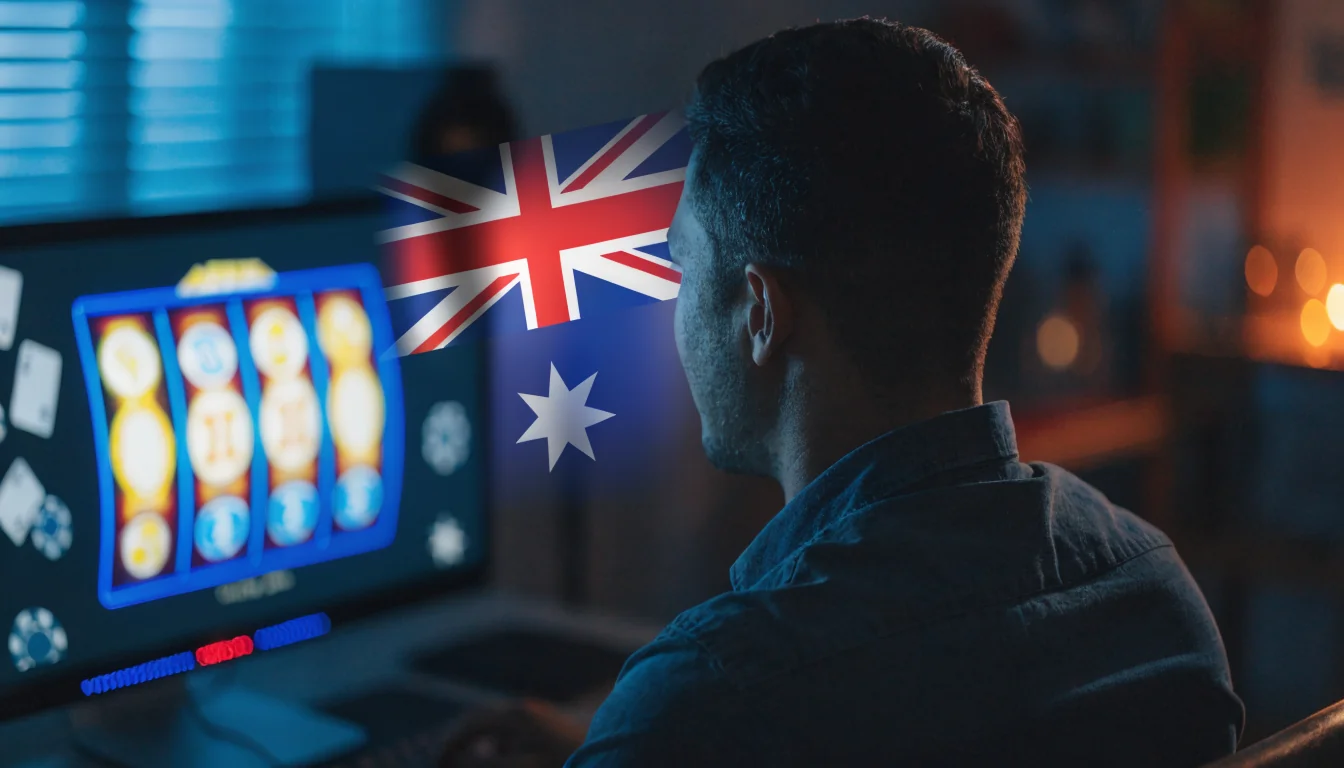
Online casino style games are prohibited. That covers slots — pokies, in the language everyone actually uses — along with poker, blackjack and roulette when offered as online casino products. The prohibition sits at the federal level, under the Interactive Gambling Act, and it doesn’t leave room for a state or territory to carve out an exception. No Australian jurisdiction issues a licence for a domestic online pokies operator, because the law makes it illegal to offer that product in the first place. There’s no application form to fill out, no regulator to petition. The door isn’t just closed, it was never built.
Who the law actually targets
Here’s the part that gets lost in most explanations, usually because leaving it vague suits whoever’s writing the explanation. The Interactive Gambling Act targets operators, not players. Offering online casino games to an Australian resident is illegal. Playing them, as an individual, is not. That asymmetry is the whole reason offshore sites still get traffic from Australia despite a domestic ban that’s been on the books for over two decades.

I’ve sat in rooms where this distinction was discussed purely as a compliance question — never as user protection, whatever the marketing later claimed. Nobody there was surprised that Australians kept playing. The operators knew exactly which side of the law carried the risk, and it wasn’t the player’s side. That’s not a loophole in the sense of an oversight. It’s the deliberate shape of the legislation.
What this means for pokies specifically
Pokies are the product most affected by this framework, and also the one where the gap between "legal to offer" and "legal to play" causes the most confusion. A pub or club pokies machine, licensed under state gambling law, is a completely different animal from an online pokies game hosted on a website. The physical machine sits inside a regulatory structure with a state regulator, inspection regimes, and licensing conditions. The online version of the same game, offered as a real-money product to someone sitting in Sydney or Perth, falls under the federal prohibition regardless of which state that person is in.
Offering online pokies to Australian players is prohibited under the Interactive Gambling Act, even if the site is offshore.
So the honest answer to "can I play online pokies in Australia" isn’t a flat no. It’s: not from an Australian-licensed operator, because there isn’t one, but individual play on an offshore-licensed site isn’t itself a criminal act for the player. Two different questions get asked as one, and the answer changes depending on which one you’re actually asking.
Poker sits in an odd spot
Poker gets grouped with slots, blackjack and roulette under the same prohibition, which surprises people who think of poker as skill-based rather than a house-edge casino game. The Act doesn’t distinguish. Online poker, when offered to Australian residents, falls under the same ban as online casino style games generally. There’s no separate licensing track for poker rooms the way there is, at the state level, for sports and racing wagering. If a platform offers real-money online poker to Australian players, it’s operating the same way an online pokies site does — outside what Australian law permits any operator to provide domestically.
In-play betting: legal is a matter of channel, not product
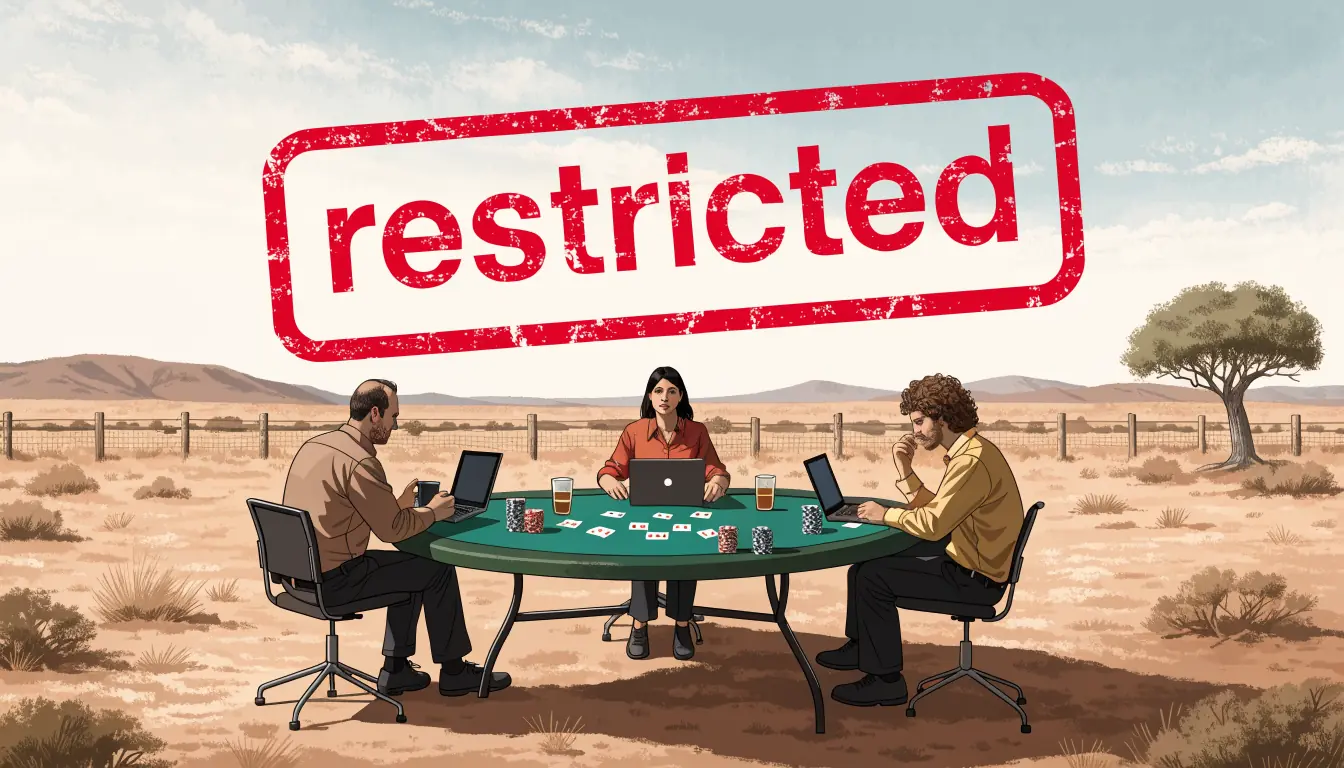
Live betting deserves its own mention here because it doesn’t fit neatly into the casino-versus-sports divide. In-play online betting is illegal under the federal framework — you can’t place a bet on an event once it’s already underway, through a website or app. But live betting by phone is legal. Same underlying activity, same event, same odds — the deciding factor is the channel the bet travels through. It’s an artefact of how the legislation was drafted, tied to the mechanics of interactive services rather than to the concept of in-play wagering itself. Nobody designing a modern product from scratch would draw the line there. But that’s where it sits.
What’s actually available, then
Given all of this, what can an Australian player actually access, legally, without wading into offshore territory?
- State-licensed land-based pokies and casino tables — physical venues, physical machines, regulated by state gambling authorities and law enforcement, not by the federal framework covered here.
- Online sports and racing betting — legal under state and territory licences, a completely separate product category from online casino games.
- Phone-based live betting — permitted where the equivalent online in-play bet would not be.
That’s the list. There’s no domestic online pokies option to add to it, no legally licensed Australian online poker room, no locally regulated online blackjack or roulette product. Anything claiming to offer those as an Australian-licensed service is either misdescribing itself or operating from offshore under a different jurisdiction’s rules entirely — which brings its own considerations around recourse and oversight that belong in a different discussion.
Why the offshore option exists at all
The gap between "illegal to offer" and "legal to play" is precisely why offshore platforms keep a foothold with Australian traffic. A site licensed in another jurisdiction isn’t bound by the Interactive Gambling Act’s prohibition on offering the service — that law reaches operators within Australia’s own regulatory grasp, not a company incorporated and licensed elsewhere. Whether that offshore licence carries any real weight if something goes wrong is a separate question, and not one this section is trying to answer. What’s factual is narrower: an individual playing on such a site isn’t committing an offence under Australian law by doing so.
That narrow fact gets stretched, in plenty of marketing copy, into something it isn’t — a suggestion that the activity itself is sanctioned, or that "offshore-licensed" carries the same weight as a domestic licence would. It doesn’t. There’s no Australian regulator standing behind that licence, no domestic dispute process, no local enforcement reaching back into it. The player not being the one breaking the law is not the same as the product being endorsed, checked, or backed by anyone here.

Worked out plainly, once. Rarely stated that way anywhere else.
Payments, Withdrawals and Player Verification: Compliance Requirements
Ask an operator’s support agent which regulator oversees their payment processing and watch the answer wander. That vagueness isn’t an accident. It’s structural. Australia doesn’t have one body watching money move through gambling accounts — it has a patchwork, and offshore sites sit mostly outside all of it.
Who actually watches the money
Land-based casinos answer to state government regulators and law enforcement agencies. A Crown or Star venue in Melbourne or Sydney has a state licensing body that can walk in, audit its cage, and pull its licence. That’s real oversight, backed by real consequences, because the operator has a physical address the regulator can visit.
Online offshore casinos have none of that. Each state and territory runs its own gambling regulator, but their authority stops at their own borders and their own licensees. A site licensed in Curaçao or Malta and taking deposits from a player in Perth isn’t answering to any Australian state body — it never applied for a licence here, so there’s nothing to revoke.

At the federal level, ACMA enforces the Interactive Gambling Act, but its power over money is narrower than people assume. ACMA can investigate and block prohibited interactive gambling services. It cannot recover funds. It cannot settle a dispute over a withheld withdrawal. If an offshore operator freezes a balance or drags out a payout indefinitely, there’s no Australian regulator whose job it is to make that operator pay. ACMA’s tools run the other way: instigating civil proceedings against operators, notifying border protection agencies about the directors and principals behind offending offshore operations, and liaising with foreign regulators who might have actual jurisdiction. None of that puts money back in a player’s account.
This is the piece that gets buried under reassuring language elsewhere. A licence badge in a footer says nothing about who answers when a withdrawal doesn’t arrive. On this market, for online casino products, the honest answer is often: nobody with enforcement power over that specific operator.
What "verification" actually means here
Every legitimate-looking offshore casino will ask for identity documents before releasing a withdrawal. This is standard KYC — Know Your Customer — practice across the industry globally, not something specific to Australian law, but it’s worth understanding what it’s actually for and what it isn’t.
KYC checks typically involve government-issued photo ID, proof of address, and sometimes a selfie or payment method verification. The stated purpose is anti-money-laundering compliance and confirming the account holder is who they claim to be. The practical effect, from having watched this from the inside, is that it also functions as a delay mechanism. A withdrawal request submitted the moment KYC documents go missing, or get flagged for "further review," or need to be resubmitted because a corner of a passport photo was cropped — that’s a withdrawal that doesn’t get paid this week.

None of this is illegal. Verification before withdrawal is a legitimate, near-universal practice, and operators have genuine compliance obligations to meet. But there’s a difference between verification as a compliance step and verification as a stalling tactic, and from outside the industry the two look identical. The only real defence is submitting clean, complete, matching documents before ever placing a bet — not after requesting a withdrawal — so there’s no excuse left to invoke.
Payment methods and the gaps in enforcement
Australian banks have increasingly blocked card transactions to known gambling merchants, and credit cards and digital currencies are excluded from legitimate wagering operations under current rules. This pushes activity toward payment rails that are harder to trace and harder for any Australian body to intervene in — prepaid cards, e-wallets registered offshore, and cryptocurrency transfers that don’t touch an Australian bank at any point.
That’s the practical mechanism behind offshore casino payments: not that they’re using some approved local method, but that they’re using whatever moves money across a border without an Australian institution in the chain. PayID, which is common for legitimate Australian wagering and lottery operators, sits inside the regulated system precisely because it runs through Australian banks that can be compelled to report and cooperate. Once a payment leaves that system — crypto wallet to crypto wallet, offshore e-wallet to offshore e-wallet — it’s also left the reach of anyone in Australia who might otherwise intervene on a player’s behalf.

The blocking effort, and its limits
Since November 2019, ACMA has had the authority to order internet service providers to block illegal offshore gambling sites, and it has used that power repeatedly. The scale of that effort is reported differently depending on the source and the date of reporting: one account puts the number of blocked illegal gambling and affiliate websites at 975 as of a 2024 publication; a later account, current to August 2025, puts the figure at 1,296 sites and affiliates blocked since 2019, alongside roughly 220 services that exited the market voluntarily rather than face enforcement. A separate figure, cited by theiaga.org, states that more than 100 illegal gambling services left the Australian market following ACMA’s enforcement push that began in 2017. These numbers don’t reconcile cleanly with each other — different sources, different cutoff dates, different definitions of what counts as a "service" versus a "site" — but the direction is consistent: enforcement has been active and growing, not static.
What blocking doesn’t do is protect a payment already sent. An ISP-level block stops new Australian traffic from reaching a domain. It does nothing for a player who deposited last month and is waiting on a withdrawal now. The operator can rotate to a new domain, keep servicing existing accounts through a different URL, and the underlying payment dispute — money sent, money not returned — sits completely outside what any block accomplishes. Site-blocking is a market-access tool, not a consumer-remedy tool. Worth knowing which one you’re relying on before assuming it covers you.
What this means practically
There is no Australian regulator that will chase a withdrawal on a player’s behalf from an offshore casino. State bodies like Liquor & Gaming NSW or the Victorian Gambling and Casino Control Commission have real authority over licensed wagering providers, including monitoring compliance under the National Consumer Protection Framework — but that authority was built for bookmakers and lottery operators holding actual state or territory licences, not for a casino operating from a jurisdiction that never granted anything to Australian regulators to enforce.
Site blocking stops new traffic but does not return money already deposited or pending withdrawals.
Anyone dealing with an offshore casino is, in effect, relying entirely on that operator’s own dispute process and whatever licensing body issued its (foreign) licence — Malta, Curaçao, Kahnawake, wherever it happens to be. Those bodies vary enormously in how seriously they take player complaints. None of them are obligated to answer to anyone in Canberra.
Keep records. Screenshot verification submissions. Save every message about a pending withdrawal, timestamped, before support chat "loses" the thread. It’s not a guarantee — nothing here is — but it’s the only leverage a player actually has when the nearest regulator with real teeth has no jurisdiction over the operator holding the money.
Australian Casino Market Overview: Reviews, Rankings and Regulatory Realities
Every casino review site eventually has to answer a question it would rather skip: reviewed against what licence? In most markets the answer is straightforward — a national gambling authority hands out permits, and a ranking can simply list who holds one. Australia doesn’t work that way. There is no domestic online casino licence to hold, because it’s illegal to offer online casino gambling here, and no regulator — state, territory or federal — has the power to grant one. So when a site claims to have "reviewed and ranked" Australian online casinos, the first thing worth checking is what exactly they think they’re ranking.
They’re ranking offshore operators. That’s not a criticism, just a fact worth stating plainly, because it changes what a ranking can honestly promise.
Why there’s no home team
I’ve watched people search for an "Australian licensed casino" the way they’d search for an Australian licensed bookmaker, assuming the same structure applies. It doesn’t. Sports betting and racing are licensed at state and territory level, and the Northern Territory Racing Commission has ended up as the de-facto hub for that industry — most national online bookmakers are licensed there, largely because the tax treatment is lighter than in other states. That’s a real regulator, issuing real licences, to real operators taking real Australian customers.

No such pathway exists for online casino games. Land-based casinos are a separate world entirely — physical premises, state government regulators, law enforcement oversight, the whole apparatus you’d expect from a casino floor. That system has nothing to do with what happens on a website. Online casino products sit outside both of these structures, in a space Australian law simply doesn’t provide for. Not heavily restricted. Not licensed but taxed differently. Not available. A ranking site that implies otherwise, even by omission, isn’t being careful — it’s being wrong.
What a ranking is actually measuring
Once you accept that any "Australian casino review" is describing an offshore site, the useful question becomes: offshore under whose rules? Because "licensed" stops meaning much if the licence in question has no jurisdiction here at all. A ranking has to be honest about the limits of that licence rather than borrowing its authority for reassurance it can’t provide.
Summary
- Australian regulators cannot enforce offshore bonus terms.
- Online casino games are prohibited, but players can still access offshore sites.
- Blocking measures limit access but do not protect deposited funds.
- Verification processes may be used to delay payouts.
- Players rely on the offshore operator’s own dispute mechanisms.
This is where the regulatory picture gets genuinely layered, and where most rankings go quiet because the layers don’t stack neatly.
- State and territory regulators — bodies like the Victorian Gambling and Casino Control Commission and Liquor & Gaming NSW — exist to police gambling within their own borders and, in the VGCCC’s case, to monitor wagering providers nationally for consumer protection compliance. Their reach was built for domestic licensees. Against an operator based overseas, with no local premises and no local licence to revoke, that reach runs out fast.
- ACMA, the federal regulator, has the opposite problem: broad legal grounds to act, limited practical tools to enforce. It can investigate offshore interactive gambling services and request that internet providers block them. It can request platforms flag or restrict access. What it cannot do is recover a player’s money or arbitrate a dispute with an operator sitting outside Australian jurisdiction. If an offshore casino delays a withdrawal or closes an account, ACMA is not the body that gets that money back.
- No single authority sits above both layers. There’s no unified gambling commission cross-referencing state consumer protection with federal blocking orders. Each body works its own patch, and an offshore operator can sit in the gap between them.
That gap is the honest subject of any Australian casino ranking. Not "which offshore site is best," but "which offshore site is least exposed to that gap" — smaller wagering disputes, cleaner payment history, a licensing body abroad that at least answers correspondence. It’s a lower bar than reviewers on other markets get to set, and pretending otherwise doesn’t raise the bar, it just hides it.
Enforcement, and what it actually changes
ACMA’s blocking program is the part of this system with the most visible activity, so it’s worth being precise about what it shows and what it doesn’t.
By one account, more than 100 illegal gambling services — including online casinos — left the Australian market after ACMA began enforcing tighter rules in 2017. A more recent figure, reported by iclg.com as of August 2025, puts the cumulative total at 1,296 illegal gambling sites and affiliates blocked since 2019, with 220 services said to have exited voluntarily. These numbers come from different points in time and different sources counting different things — one tracks operator exits, the other blocked domains and affiliates — so they shouldn’t be read as two versions of the same statistic. They’re separate snapshots of an enforcement effort that’s been running for years and clearly hasn’t finished.
What this activity demonstrates is that ACMA can shrink the visible market. What it doesn’t demonstrate is that the market disappears. Blocked domains reappear under new names. Affiliate sites get rebuilt faster than they get taken down. This is the mechanic reviewers rarely spell out: a "top casinos" list compiled today can contain a domain ACMA blocks next month, and the list either updates or quietly becomes a directory of dead links. Longevity in this market isn’t a mark of quality — it’s a mark of one operator being harder to pin down than another.

There’s also a boundary to ACMA’s authority that matters for anyone judging how "regulated" this space really is. The law prohibits gambling advertising in Australia, and that specific wording means ACMA has no power to force platforms like Facebook to block gambling ads simply because they’re targeting Australian users from outside the country. Enforcement against the operator’s product is one thing; enforcement against how that product gets in front of people is another, and the second one has a hole in it that the regulator itself can’t close.
Reading a ranking with this in mind
None of this means every offshore casino review is worthless — it means the review is answering a narrower question than it usually claims to. A responsible overview of this market should be doing a few specific things, and it’s fair to check for them:
- Naming which offshore jurisdiction licensed the operator, rather than using “licensed” as a stand-alone reassurance.
- Separating land-based and online regulation explicitly, since conflating the two lends an online product a legitimacy it doesn’t have.
- Acknowledging that state regulators can’t act on offshore complaints, so a VGCCC or Liquor & Gaming NSW mention isn’t dressed up as consumer protection it can’t deliver here.
- Treating ACMA’s blocking activity as ongoing, not historical — a site absent from a block list today says nothing about tomorrow.
- Being upfront about what happens when something goes wrong — no regulator here recovers funds from an offshore operator on a player’s behalf.
A ranking that does these things is measuring something real: relative caution, not endorsement. A ranking that skips them and hands out star ratings like it’s comparing licensed local operators is describing a market that, under Australian law, doesn’t exist.
Regulatory realities, not marketing categories. That’s the whole overview.
Created by the ”Casino iPad Info” editorial team.