Live Blackjack Online Casino Australia: 2026 Guide
 Available in US
Table of Contents
- Online Blackjack Casinos Accessible to Australian Players
- Live Dealer Blackjack: What Australian Players Need to Know
- Regulatory Landscape for Live Blackjack in Australia (2026 Outlook)
- How to Play Blackjack Online: Rules and Basics
- Bitcoin and Bonus Policies for Australian Blackjack Players
- Effective Blackjack Strategies for Online Play
- Key Considerations for Choosing the Best Online Blackjack Site
- Winning Tips and the Concept of ‘Switch’ in Blackjack
- Blackjack Game Variants and Their Availability
- Official Blackjack Rules and House Edge Overview
Online Blackjack Casinos Accessible to Australian Players
There’s no such thing as a locally licensed online blackjack casino in Australia. Not one. If a site claims to hold an Australian gambling licence for real-money casino games, that claim is false on its face — no such licence exists, and none can be issued. The Interactive Gambling Act makes it illegal to offer online casino gambling from within Australia, and there’s no application form, no regulator office, no path to compliance that ends in a legitimate domestic operator. I’ve seen the paperwork side of this industry, and the honest answer to "where’s the Australian licence" is: there isn’t one to show.
The dates matter less than the pattern. Some sources point to 1997 legislation prohibiting online casino games for Australian residents, others cite the 2001 Act as the operative law — the sources disagree on which year did the work, and I won’t pretend one version is settled fact. What’s consistent across both is the substance: slots, poker, roulette and blackjack offered as online casino products are prohibited under Australian law, full stop. "Prohibited" here means prohibited for the people running the show, not for the person clicking "deal."
Before diving into live blackjack tables, it’s worth checking how each casino handles licensing, bonuses, and deposits, since these details shape your real-money experience beyond the game itself.
License: Curacao – Antillephone N.V. (Versus Odds B.V.) · Bonus: up to EUR 2,000 across 5 deposits + 200 free spins · Min. deposit: EUR 20 Licensed under Curacao’s Antillephone framework, this operator offers a multi-deposit bonus package spread across five deposits plus free spins, with a modest minimum deposit requirement.
Bonus: up to A$750 + 50 jackpot spins, 35x wagering · Payout speed: crypto ~90 minutes, fiat 1-5 days · Min. deposit: A$30 Offers a bonus paired with jackpot-themed free spins and clearly stated wagering terms, while crypto users benefit from notably fast payout processing compared to fiat withdrawals.
License: Curacao eGaming (Hollycorn N.V., since 2017) · Bonus: 225% up to A$1,540 + 600 free spins across 4 deposits, 20x wagering · Min. deposit: A$20-30 (depends on the offer) An established operator under Curacao eGaming since 2017, providing a substantial multi-deposit bonus with free spins and reasonable wagering requirements.
Bonus: up to A$7,500 + 550 free spins across 10 deposits, 50x wagering · Payout speed: crypto under 1 hour, PayID 1-3 business days · Min. deposit: A$20 (A$30 to qualify for the bonus) Stands out for a large bonus package spread across ten deposits with free spins, plus fast crypto payouts and short PayID processing times.
License: Curacao Gaming Control Board · Bonus: up to A$5,000 + 400 free spins Licensed under the Curacao Gaming Control Board, this operator features a sizeable welcome bonus combined with a solid batch of free spins.
License: Curacao Gaming Control Board OGL/2023/174/0082 (Dama N.V.) · Bonus: up to A$5,000 + 300 free spins across 4 deposits Holds a specific Curacao Gaming Control Board license and spreads its generous bonus and free spins offer across four deposits.
License: Curacao · Bonus: 100% up to A$500 + 200 free spins, 10x wagering · Payout speed: crypto 30-60 minutes, fiat 1-5 days · Min. deposit: A$10 A Curacao-licensed casino with a low minimum deposit and favorable wagering terms, plus quick crypto payout times relative to fiat withdrawals.
License: Curacao eGaming OGL/2023/174/0082 (Dama N.V.) · Bonus: up to A$10,000 + 500 free spins across 4 deposits · Min. deposit: A$15 Licensed under Curacao eGaming, this operator offers one of the larger bonus packages on the list spread over four deposits, with an accessible minimum deposit.
License: Curacao OGL/2024/1335/0780 · Bonus: up to A$1,000 + 150 free spins, wager-free · Min. deposit: EUR 20 Holds a recent Curacao license and offers a wager-free bonus structure paired with free spins, which stands out for simplicity in terms.
License: Curacao Gaming Control Board OGL/2023/176/0095 (Hollycorn N.V.) · Bonus: up to A$11,000 + 300 free spins (code NEO100) Licensed by the Curacao Gaming Control Board, this operator provides one of the largest bonus amounts on the list along with free spins via a bonus code.
Where Australians actually play
Every site an Australian player uses for real-money blackjack is, by definition, an offshore operation. These platforms hold licences from other jurisdictions — Malta, Curaçao, various island regulators — and accept Australian traffic despite Australian law explicitly barring the practice on the supply side. The operator is breaking the law by offering the service. The player logging in from Brisbane or Perth is not committing an offence by playing.
That distinction is the whole shape of the market. It’s why blackjack casinos serving Australians exist in a kind of legal shadow: technically illegal to operate, not illegal to use, and effectively unenforceable against operators sitting outside Australian jurisdiction. Names that turn up repeatedly in this space include Casino Mate, Fair Go, HellSpin, Joe Fortune, King Johnnie, Neo Spin Casino and PlayAmo. None of them can point to an Australian licence, because the licence they’d need doesn’t exist. Any of them can point to a foreign one, because that’s the only kind on offer.
What "accessible" actually means
Accessible doesn’t mean endorsed, and it doesn’t mean regulated by anyone with jurisdiction over the operator’s conduct. It means the site loads, accepts an Australian signup, and processes bets in a currency an Australian can use. That’s a technical fact, not a legal blessing. When a site’s marketing leans on words like "licensed" or "regulated," the honest question is licensed by whom, and regulated for whose benefit — usually not the Australian player’s, since no Australian body has the standing to intervene in that operator’s day-to-day conduct.

This is also why the site footer matters more here than on most consumer products. A footer naming a real foreign regulator is at least verifiable. A footer with no licence mentioned at all, or a vague reference to "international compliance," is a footer worth reading twice.
The practical landscape
For an Australian player, the online blackjack market breaks down less by "legal versus illegal" — since the law targets the house, not the punter — and more by who’s actually offshore and operating in the open versus who’s cutting corners on basics like identity checks or complaint handling. The operators named above are all offshore by necessity; there’s no alternative category of "domestic casino blackjack site" to compare them against, because that category is empty in Australia and will stay empty unless the law itself changes.
What doesn’t change with the offshore setup is the game itself. Blackjack, whether random-number-generated or run by a croupier, arrives through the same kind of platform infrastructure — a licence issued elsewhere, servers hosted elsewhere, payment processing built around the fact that Australian banks and card networks won’t touch it the way they’d touch a sports bet with a local bookmaker. Sports betting sits in a different bucket entirely, licensed properly at state and territory level. Casino-style blackjack doesn’t get that treatment and isn’t going to.
No Australian licence
There is no Australian gambling licence for online blackjack; any claim that a site holds one is false and misleading.
Why this matters before choosing anywhere to play
Knowing the market is entirely offshore changes what questions are worth asking about a site. "Is it licensed in Australia" isn’t a real question — the answer is always no, and any operator implying otherwise is misrepresenting itself. The better questions are about the foreign licence a site does hold, how it handles identity verification, and how transparent it is about the fact that it’s operating in a legal grey zone rather than pretending otherwise.
I’ve found the operators who are straightforward about their offshore status — foreign licence stated plainly, no pretence of Australian approval — tend to be the ones worth a second look. The ones who dress up a Curaçao licence in language designed to sound local are doing exactly what the phrase "buyer beware" was invented for.
None of this is a live-dealer question yet — that’s a separate piece of the picture, with its own mechanics and its own offshore workarounds. What matters at this stage is simpler: understanding that the entire Australian-facing blackjack market, live or otherwise, sits outside Australian licensing by design, not by accident.
Live Dealer Blackjack: What Australian Players Need to Know
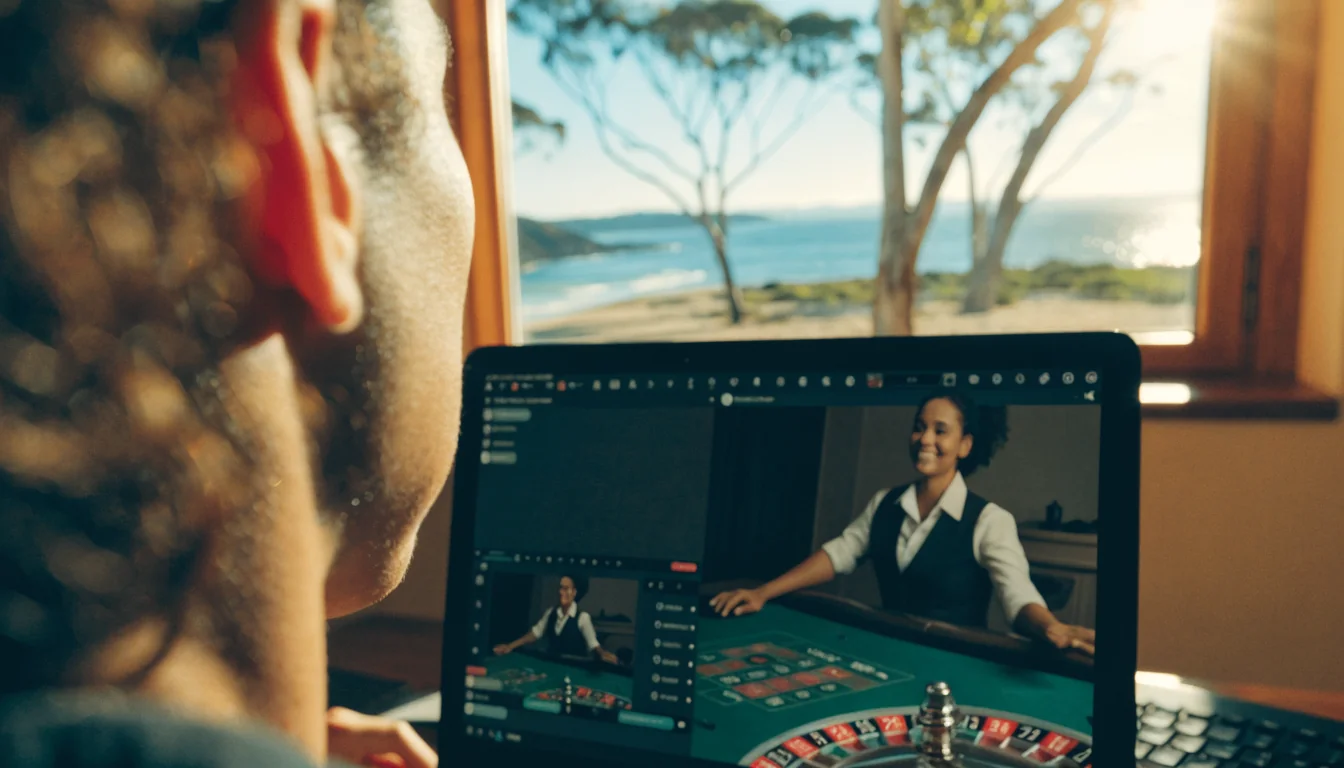
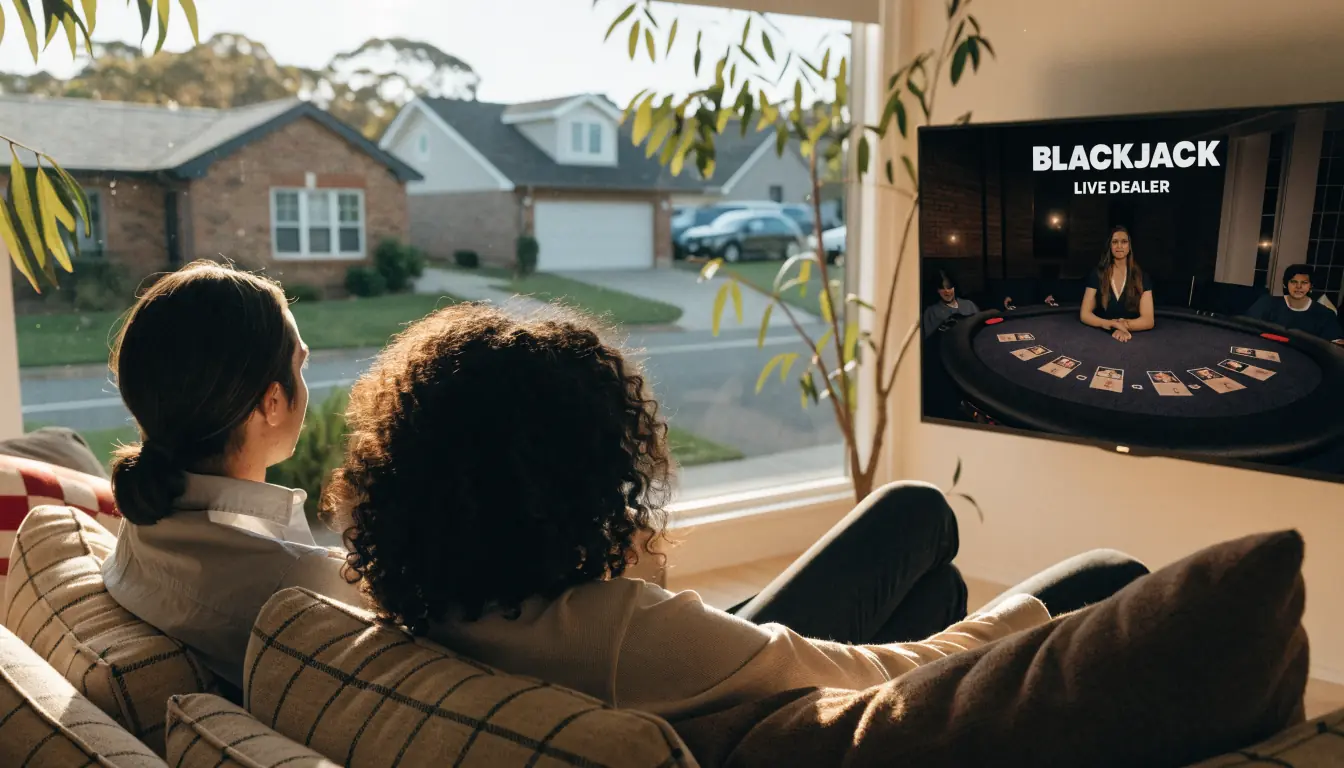
A live dealer table looks like the closest thing to a real casino floor you can get from a couch in Perth or Brisbane. A croupier deals real cards, a camera streams it in real time, and the outcome isn’t decided by a random number generator sitting somewhere in a server rack. For a lot of players that distinction matters more than any bonus offer. It also creates a slightly different legal picture from the general online casino landscape covered above, and it’s worth being precise about why.
The Interactive Gambling Act 2001 prohibits online casino style games — slots, poker, roulette, and blackjack — from being offered to people in Australia. That prohibition doesn’t carve out an exception for the live‑dealer format. A blackjack hand dealt by a croupier in a studio is still blackjack under the law. The medium changed; the legal category didn’t.
Why "live" complicates the picture
Here’s where it gets interesting, and where I’ve seen a lot of confusion play out in forums and comment sections. Australian law treats live betting — wagering on an event as it unfolds, like an in‑play sports bet — differently from live dealer games. In-play online betting is illegal, though placing that same live bet by phone is legal. That rule was written for sports and racing markets, not for casino tables, but the word "live" gets people mixing up two separate regimes.
Live dealer blackjack isn’t in-play sports betting. It falls under the broader ban on online casino games, the same one that catches slots and roulette. So the relevant restriction isn’t the in-play betting rule — it’s the casino games prohibition. Two different sections of the same law, two different mechanisms, one shared result: neither is meant to be offered to Australian residents by an operator without the right footing to do so, and no operator currently has that footing domestically.
How offshore studios reach Australian screens anyway
None of this stops the games from being visible. Offshore-licensed platforms run live blackjack studios — usually branded through providers like Evolution Gaming, Pragmatic Play, or NetEnt — and stream them to whoever can load the page, Australian IP addresses included. These studios are physically based overseas, licensed overseas, and answerable to overseas regulators. The "croupier dealing from Riga" model isn’t a workaround dressed up to look legal; it’s simply outside the reach of the law that would stop it if it were run from Sydney.
Offshore studios
Offshore‑licensed platforms can stream live dealer tables to Australian IP addresses, but they remain subject to the regulator of the jurisdiction that issued their licence.
This is the same structural gap discussed in the previous section on general casino access, just sharper here because live dealer tables are often the headline product offshore operators use to look legitimate. A real person shuffling real cards on camera reads as more trustworthy than a random number generator, and operators know it. The trust signal is genuine — the dealing itself isn’t rigged any more than a physical casino table would be — but it doesn’t change the regulatory status of the operator offering it.
What this means in practice
For an individual player, none of this is a personal offence. The Interactive Gambling Act targets the businesses providing the service, not the person sitting at the table. Playing live blackjack through an offshore site isn’t something an Australian resident gets prosecuted for. What it does mean is that there’s no local complaints body standing behind the game, no domestic regulator who licensed the studio, and no local court that has jurisdiction if a dispute over a hand or a payout ever needs resolving.
That’s not a small print detail — it’s the whole arrangement in one sentence. You’re playing a real game, dealt by a real person, on a real feed. You’re just doing it entirely on the operator’s terms, in the operator’s jurisdiction, under the operator’s regulator.
What to actually check before sitting down
- Which regulator licensed the platform — Malta Gaming Authority and the UK Gambling Commission are the two names that show up most often behind offshore live dealer products.
- Who’s running the software — Evolution Gaming, Pragmatic Play, Microgaming and NetEnt are the studios behind most live blackjack feeds you’ll encounter; the branding usually appears in the game lobby.
- Age gating — a legitimate offshore operator will still restrict access to adults only, in line with the minimum gambling age applying to Australian players.
None of that turns an offshore live dealer table into a locally regulated one. It just tells you which set of rules — Malta’s, the UK’s, wherever the licence actually sits — governs the game you’re looking at, since Australia’s own framework doesn’t extend to it. How that federal and state framework is actually structured, and where enforcement is heading, is worth walking through properly next.
Regulatory Landscape for Live Blackjack in Australia (2026 Outlook)
Ask which regulator oversees live blackjack casino operations in Australia and you won’t get a clean answer, because there isn’t one. There’s no single overarching statute and no single overarching gambling authority — the whole system is split between federal and state/territory layers, and each layer was built for a different problem at a different time. That’s not an accident. It’s what happens when you regulate the casino industry state by state for a century, then bolt an internet-era federal law onto the top of it.
No local regulator
Australian authorities do not regulate offshore live‑dealer blackjack sites, so players have no domestic recourse if something goes wrong.
The federal layer: ACMA
At the Commonwealth level, the Australian Communications and Media Authority enforces the Interactive Gambling Act 2001. ACMA’s job is narrow and specific: it polices which services can be offered to Australians online, not how a casino floor in Perth runs its blackjack tables. Its remit is the wire, not the venue. That distinction matters more than it sounds — it’s the reason state regulators and ACMA never really overlap, and why "regulated" means something completely different depending on which body you’re talking about.
The state layer: a patchwork, not a system
Land-based casinos — the physical rooms with actual croupiers dealing actual cards — are regulated by state government regulators and law enforcement agencies, entirely separate from ACMA’s federal online remit. Every state and territory runs its own regulator, with its own licensing conditions, its own inspectors, its own definition of what a compliant table looks like.
The Victorian Gambling and Casino Control Commission is a useful example of how far this reach extends. VGCCC doesn’t just watch Victorian operators — it monitors wagering service providers based anywhere in the country for compliance with the National Consumer Protection Framework. So a bookmaker licensed in the Northern Territory can still answer to a Victorian regulator on consumer protection grounds, even without a Victorian licence. That’s the patchwork in action: overlapping jurisdiction without a shared rulebook.
Then there’s the Northern Territory Racing Commission, which functions as Australia’s de-facto online gambling regulator — not because the law designates it that way, but because it licenses most of the national online bookmakers, drawn there by lower tax rates. "De-facto" is doing real work in that sentence. No legislation names the NTRC as the country’s central online gambling authority. It became one by attracting the licensees, the way a low-tax jurisdiction always ends up running the table by default rather than by design.
None of these bodies — ACMA, VGCCC, NTRC, or any state commission — licenses, oversees, or has any authority over an offshore live blackjack platform serving Australian players. That’s the piece worth sitting with. The regulatory apparatus is real, layered, and genuinely active, but it was built to govern sports wagering, land-based casinos, and a handful of licensed local products. Live blackjack streamed from a studio outside Australian jurisdiction sits outside all of it.
What 2026 is likely to look like
Nothing in the current structure points toward Australia licensing domestic online casino operators by 2026. The Interactive Gambling Act 2001 still prohibits online casino games — blackjack included — and there’s no legislative proposal on the table to change that federal position. What’s more plausible is incremental tightening of the enforcement side: more ISP-blocking orders, more pressure on payment rails, more coordination between ACMA and state consumer-protection bodies like VGCCC extending their monitoring reach further across jurisdictions.
The NTRC’s role probably doesn’t change either. It has no reason to start licensing live-dealer casino products when its entire commercial position rests on sports and race wagering. Expecting it to become an online casino regulator by 2026 misreads why it holds influence in the first place.
So the honest projection isn’t "new licensing regime." It’s more of the same architecture, doing more of what it already does: federal enforcement against access, state regulators policing consumer protection wherever they can reach, and a live blackjack market that continues operating from offshore, outside the perimeter of any Australian regulator. The gap between "illegal to offer" and "not illegal to play" isn’t closing. If anything, the fragmentation described above is the reason it hasn’t closed already — nobody in this structure has the mandate to close it single-handedly.
Whether that changes by 2026 depends less on regulatory appetite than on political will to unify a system that currently has none. Nothing in the current facts suggests that unification is coming.
How to Play Blackjack Online: Rules and Basics
The mechanics don’t change because there’s a screen instead of a felt table. Cards get dealt, hands get scored, and the house still pays out on the same logic it always has. What changes online is the pace — no shuffling delays, no chip counting, just a betting interface and a "deal" button.
The goal
Get closer to 21 than the dealer without going over. That’s the whole premise. Everything else is procedure.
Card values
- Number cards (2–10) count at face value.
- Face cards — jack, queen, king — count as 10.
- An ace counts as 1 or 11, whichever helps the hand more.
A hand of an ace plus a ten-value card is a "blackjack" — the best possible result, and it usually pays out at odds better than a standard win.
The betting flow
Before any cards appear, you place a wager. On a screen, that’s clicking or tapping a chip value rather than sliding chips across baize, but the sequence is identical to a physical table:
- Place your bet.
- Dealer deals two cards to you, two to themselves (one hidden, in most variants).
- You decide how to play your hand.
- Dealer reveals their hidden card and plays out their hand by fixed rules.
- Payouts settle automatically.
Player decisions
Once you see your cards, the options on offer are usually some combination of:
- Hit — take another card.
- Stand — keep your current total and end your turn.
- Double down — double your bet in exchange for exactly one more card.
- Split — if your two cards match in value, separate them into two hands, each with its own bet.
- Surrender — where available, forfeit half your bet and end the hand early rather than risk losing it all.
None of these are exotic. They’re the same choices you’d make standing at a table, just delivered through buttons instead of hand signals to a croupier.
Dealer rules
The dealer doesn’t get to choose. Standard house rules force them to hit until their hand reaches a set threshold, then stand — no judgment calls, no bluffing. That fixed behaviour is what the house edge is built on, and it’s worth remembering when a hand doesn’t go your way: the dealer wasn’t reading you, they were following a script.
Payouts
A win against the dealer’s hand typically pays even money on the base bet. A blackjack — ace plus ten-value card on the first two cards — usually pays at a better rate than a standard win. Anything beyond that "usually" isn’t something an operator publishes in the open; payout tables sit inside the game rules screen, and they’re worth reading before the first bet, not after the first loss.
Where this fits in Australia
This is where the practical guide runs into the legal one. Online casino games — slots, poker, roulette, and blackjack among them — are prohibited under the Interactive Gambling Act 2001, and there’s no domestically licensed real-money casino operator an Australian player can turn to. The rules above apply wherever blackjack is dealt, but the venue offering the game sits outside Australia’s regulatory reach, not inside it.
Bitcoin and Bonus Policies for Australian Blackjack Players
Every so often a message board post asks whether depositing in Bitcoin gets around the whole licensing mess. It doesn’t, and the question misunderstands what the restriction actually covers. Online casino gambling — including blackjack — is prohibited for operators offering it in Australia under the Interactive Gambling Act 2001, and no domestic licence exists for anyone to run this business legally in the first place. Bitcoin doesn’t change what’s being offered. It’s still an online casino game, just paid for differently.
I’ve seen operators pitch crypto as "instant" and "borderless," and both words are doing a lot of work to avoid saying what’s true: it moves the transaction outside a banking system that would otherwise leave a paper trail. That’s a payment-rail decision, not a legal one. The game on the other side of the deposit — a blackjack table dealt in real time or by algorithm — falls under the same prohibited category regardless of what currency bought the chips.
Bonuses: the part nobody reads carefully
Bonus terms are where the gap between marketing copy and actual entitlement shows up fastest. A "welcome package" or "no deposit bonus" is a contract, not a gift, and the wagering requirements attached to it determine whether the money is ever withdrawable. I’ve watched players celebrate a bonus credit and then discover, three clicks into the terms page, that the conditions were structured to make cashing out unlikely long before they got there.
What should be non-negotiable, regardless of jurisdiction:
- Wagering requirements displayed before the bonus is accepted, not after.
- Identity verification completed before any withdrawal request, not triggered only when a player tries to cash out a win.
- No pressure tactics disguised as “limited time” bonus offers that push deposits without giving time to read terms.
None of this is generosity on an operator’s part — it’s the baseline a site should meet before a bonus is worth touching. If the terms aren’t visible until after you’ve opted in, that’s a red flag on its own, independent of which currency funded the account.
Where the money question actually sits
The honest position is this: Australians playing blackjack at offshore sites aren’t breaking the law by playing, but the operators offering these games — whether they accept card payments, e-wallets, or Bitcoin — are supplying a product that Australian law prohibits from being offered domestically. That prohibition doesn’t distinguish between payment methods. It targets the offering of the casino game itself.
So the practical question isn’t "does this site take crypto," it’s whether the site is upfront about verification requirements and bonus conditions before money changes hands. A site that buries wagering terms, delays ID checks until withdrawal, or dangles a "free" bonus without disclosing the strings attached is telling you something about how it treats every other part of the relationship too. Payment method is a footnote next to that.
Effective Blackjack Strategies for Online Play
Strategy tables get sold as secret knowledge. They aren’t. Every serious player has seen the same chart — it just takes a while to trust it enough to follow it when a hand feels wrong.
Basic strategy is a fixed set of decisions for every hand total against every dealer upcard. It doesn’t guess. It tells you when to hit, stand, double, or split based on probability, not instinct. I learned it the slow way, by tracking my own losses and noticing they clustered around the same few decisions — standing too early on soft totals, splitting pairs I should have left alone. Once I started following the table instead of my gut, the losses evened out. Not into wins. Into something closer to what the house edge actually predicts.
Where the edge comes from
The house edge on blackjack isn’t fixed the way it is on a slot reel. It moves depending on how well the player plays. A player working from memory or superstition hands the house a bigger edge than the game requires. A player working from basic strategy narrows that gap to close to its mathematical minimum. Nothing closes it entirely — the house always keeps something back, usually through the order of play, since the dealer acts last.
Building on the basics
Once basic strategy is automatic, the next layer is counting — tracking the ratio of high to low cards left in the shoe to judge when the remaining deck favours the player. It works at physical tables dealt from a shrinking shoe. It works far less against continuous shuffling machines or software that reshuffles after every hand, which is most of what’s on offer online. I spent time trying to count through an auto-shuffler before realising the deck never actually depletes — there’s no advantage left to track.
That doesn’t make advanced play pointless online, it just shifts what "advanced" means:
- Bankroll discipline — deciding a session’s limit before sitting down, not while chasing a loss.
- Bet flatness — keeping wager size consistent rather than escalating after a loss, which changes emotional pressure, not odds.
- Table selection — favouring rule sets that pay better on naturals and allow doubling on more totals, since these details shift the house edge more than any betting pattern does.
- Reading the table layout — knowing where insurance, doubling and splitting are offered before the hand starts, so decisions aren’t made under time pressure.
None of this promises a win. What it does is remove the unforced errors — the moves that hand the house more than the game already takes. Random number games running blackjack logic behave the same way as a dealt shoe in terms of odds per hand, even without a depleting deck to read. The strategy table still applies. It’s the counting that doesn’t travel.
Key Considerations for Choosing the Best Online Blackjack Site
No site chasing Australian players holds a domestic licence, because none exists for this kind of product. So "licensed" on a blackjack lobby always points offshore — Malta, Curaçao, sometimes the UK. That’s not a red flag by itself. It’s just the only kind of licence on offer. The question worth asking isn’t whether a licence exists, but what it actually covers: dispute resolution, fund segregation, audited RNG for the digital tables. A licence badge with no linked regulator page behind it tells you nothing.
Security works the same way. Look past the padlock icon in the browser bar — that’s baseline, not a selling point. What matters is whether the site publishes who audits its shuffling algorithms for the non-live tables, and whether a live dealer stream comes from a studio run by a recognisable provider rather than an anonymous feed. I’ve seen operators dress up a generic white-label build with borrowed graphics from a real studio; the tell is usually inconsistent branding between the lobby and the table itself.

Responsible-gambling tools are where a lot of sites do the minimum and call it care. Deposit limits, session timers, self-exclusion — these should be reachable in a couple of clicks, not buried in a settings menu three layers deep. If a site makes you email support to set a limit, that’s the site telling you what it actually thinks of the feature.
On complaints: Australian state regulators like the VGCCC and Liquor & Gaming NSW can and do act against licensed wagering operators, but they have little reach into an offshore casino’s operations. That means the only real recourse if something goes wrong sits with the operator’s own licensing body, if it has one worth naming, or with an independent dispute-resolution service the site is actually a member of — not just claims to respect.
A few practical checks before signing up:
- Licence transparency — the regulator is named, not just implied, and the licence number resolves to something real.
- Named game providers — live tables running on recognisable studio software rather than unbranded streams.
- Visible limit-setting tools — not hidden behind a support ticket.
- A real complaints path — an ADR body or ombudsman the operator is actually signed up to, stated plainly, not just “contact us.”
- Clear bonus terms displayed before you claim anything — not after.
None of this replaces a domestic guarantee, because there isn’t one. It just separates operators who treat disclosure as a formality from ones that treat it as an obligation.
Winning Tips and the Concept of ‘Switch’ in Blackjack
Most advice on "how to win" at blackjack online is really advice on how to lose less. There’s a difference. No tip closes the house edge entirely — it’s built into the rules, not the felt. What separates a session that ends in the black from one that doesn’t is discipline dressed up as strategy.
A few habits actually move the needle:
- Set a loss limit before the first hand, not after the tenth. Once money is down, judgement gets worse, not better.
- Play fewer hands at higher attention rather than many hands on autopilot. Live dealer tables run slower than RNG tables by design — use that pace.
- Track the table rules, not the dealer. Payout ratios, whether the dealer stands or hits on soft totals, how many decks are in play — these change the maths more than any “feel” for a hot table.
- Walk away after a clear win target, same as the loss limit. The house edge doesn’t reset because you’re ahead; it just keeps working on the next hand.
What "Switch" actually means
Blackjack Switch is a specific variant, not a slogan. The player is dealt two hands instead of one and can swap the second card between them — trading a weak hand for a stronger one. It sounds like an edge handed to the player, and in a narrow sense it is: the swap improves your odds of building two strong hands instead of one. The catch is baked into the rules elsewhere — dealer blackjack usually only pushes against player blackjack, and a dealer total of 22 typically pushes against anything except player blackjack. The "gift" of the switch is priced back in before you ever touch it.
None of this changes the wider picture. ACMA has been ordering Australian ISPs to block offshore gambling sites since November 2019, and the operators still reachable are the ones that haven’t been caught yet, not the ones that were vetted and approved. Tips help inside a session. They don’t change who’s licensing the table.

Blackjack Game Variants and Their Availability
"Blackjack" on an offshore lobby page is a category, not a single game. Click through and you’ll find European Blackjack, Atlantic City Blackjack, Vegas Strip, Multi-Hand, Perfect Pairs, and half a dozen branded tables sitting under that one word, each with its own deck count, dealer rules and side bets. None of this is standardised — a site builds whatever mix its game providers licence to it, and the naming isn’t policed by anyone.
That matters more in this market than most, because the whole category — "slots, poker, blackjack, and roulette," as the law lists it — is prohibited under the Interactive Gambling Act 2001. Nothing on an offshore lobby is filling a gap left by a local licensing scheme. There isn’t one. There are no domestically licensed real-money casino operators for Australian players to compare variants against, so "availability" here means whatever an offshore brand chooses to switch on for its player base, not a menu shaped by local rules or a local regulator’s approval process.
Practically, that means variant availability can change without notice, differ between two offshore brands running the same game studio, or vanish from one country’s version of a lobby while staying live in another. I’ve seen European Blackjack listed on a site one month and gone the next, no explanation offered because none is owed.
None of this touches how any variant is actually played — deck count, dealer stand rules, insurance offers vary by version and belong in the rules discussion, not here. What’s worth carrying forward is simpler: the label on the table tells you the ruleset, not the legitimacy of the site running it. Those are separate questions, and only one of them has a straight answer in Australia right now.
Official Blackjack Rules and House Edge Overview
The rules of blackjack casino play don’t change much between variants: get closer to 21 than the dealer without going over, face cards count as ten, an ace counts as one or eleven, and a two-card 21 beats any other winning hand. What shifts from one table to another is the fine print — how many decks, whether the dealer stands or hits on soft seventeen, whether you can double after splitting. Those details, not the headline rules, decide the house edge.
House edge is just the average share of every wager the table keeps over time, built into the rule combination before a single card is dealt. Fewer decks and dealer-stands-on-soft-17 favour the player slightly; the reverse favours the house. No operator publishes a single number that applies everywhere, so treating any figure as fixed across sites is guesswork dressed up as fact.
None of this changes the legal position covered earlier. Blackjack, like all online casino games, sits outside the Interactive Gambling Act 2001’s permitted list — a rule set worth knowing, not a game Australian law allows local operators to offer.
Written by the editors at Casino iPad Info.