
Best Pokies in Perth: Mechanics, RTP and Payouts Explained

Understanding Pokies: Mechanics, RTP, and Volatility
Ask ten people what a pokie actually does and nine will describe the lights, the sound, maybe the feeling of a near-miss. Almost nobody describes the math underneath, and that’s not an accident. The math is where the decisions that matter get made — by the studio that built the game, not by the person spinning it. Spend enough time around the operational side of this business and you start reading a game the way a mechanic reads an engine: not for the paint job, for what’s turning under the hood.
What a spin actually is
Every pokie, whether it sits in a cabinet at a venue or loads in a browser tab, runs on a random number generator. The RNG produces an outcome the instant the spin is triggered — the reels spinning on screen are a presentation layer, a bit of theatre wrapped around a number that was already decided. There’s no "warming up" a machine, no pattern to catch, no rhythm to exploit. Each spin is independent of the one before it. I know how unsatisfying that sentence is to anyone who’s ever felt a machine was "due," but the independence of each spin is the one piece of mechanics that doesn’t bend to opinion.
Since online pokies now sit alongside Perth’s land-based options, it helps to know which platforms back up their slot libraries with solid licensing, fair bonus terms, and reliable payouts before you sign up.
License: Curacao – Antillephone N.V. (Versus Odds B.V.) · Bonus: up to EUR 2,000 across 5 deposits + 200 free spins · Min. deposit: EUR 20 Licensed by Curacao’s Antillephone N.V., this operator offers a multi-deposit welcome package worth up to EUR 2,000 plus 200 free spins, with a modest EUR 20 minimum deposit to get started.
Bonus: up to A$750 + 50 jackpot spins, 35x wagering · Payout speed: crypto ~90 minutes, fiat 1-5 days · Min. deposit: A$30 Kingmaker pairs a bonus of up to A$750 with 50 jackpot spins under 35x wagering, and stands out for fast crypto payouts of around 90 minutes alongside a low A$30 minimum deposit.
License: Curacao eGaming (Hollycorn N.V., since 2017) · Bonus: 225% up to A$1,540 + 600 free spins across 4 deposits, 20x wagering · Min. deposit: A$20-30 (depends on the offer) An established Curacao-licensed operator running since 2017, Playfina offers a generous 225% bonus up to A$1,540 with 600 free spins spread across four deposits under 20x wagering.
Bonus: up to A$7,500 + 550 free spins across 10 deposits, 50x wagering · Payout speed: crypto under 1 hour, PayID 1-3 business days · Min. deposit: A$20 (A$30 to qualify for the bonus) Ricky Casino offers one of the larger bonus packages here, up to A$7,500 plus 550 free spins across ten deposits, and backs it with quick crypto payouts and PayID support within a few business days.
License: Curacao Gaming Control Board · Bonus: up to A$5,000 + 400 free spins Licensed by the Curacao Gaming Control Board, JustCasino provides a substantial welcome offer of up to A$5,000 with 400 free spins.
License: Curacao Gaming Control Board OGL/2023/174/0082 (Dama N.V.) · Bonus: up to A$5,000 + 300 free spins across 4 deposits Holding a Curacao Gaming Control Board licence under Dama N.V., SpinsUp offers up to A$5,000 plus 300 free spins spread across four deposits.
License: Curacao · Bonus: 100% up to A$500 + 200 free spins, 10x wagering · Payout speed: crypto 30-60 minutes, fiat 1-5 days · Min. deposit: A$10 Wild Tokyo keeps entry costs low with a A$10 minimum deposit and a 100% bonus up to A$500 plus 200 free spins under just 10x wagering, while also offering fast crypto payout times.
License: Curacao eGaming OGL/2023/174/0082 (Dama N.V.) · Bonus: up to A$10,000 + 500 free spins across 4 deposits · Min. deposit: A$15 LevelUp Casino, licensed under Curacao’s Dama N.V. framework, features one of the largest bonuses on this list at up to A$10,000 with 500 free spins across four deposits, and a low A$15 minimum deposit.
License: Curacao OGL/2024/1335/0780 · Bonus: up to A$1,000 + 150 free spins, wager-free · Min. deposit: EUR 20 Vegaz Casino operates under a Curacao licence and offers a wager-free bonus of up to A$1,000 plus 150 free spins, appealing to players who prefer fewer strings attached.
License: Curacao Gaming Control Board OGL/2023/176/0095 (Hollycorn N.V.) · Bonus: up to A$11,000 + 300 free spins (code NEO100) Neospin, licensed by the Curacao Gaming Control Board under Hollycorn N.V., offers a large bonus of up to A$11,000 with 300 free spins via a dedicated bonus code.
What does bend, legitimately, is how the outcomes are distributed over time — and that’s where RTP and volatility come in. These two numbers, more than any theme or bonus feature, describe what a game will actually do to a bankroll over a session.
RTP: the number that describes millions of spins, not your session
RTP stands for Return to Player, and it’s a long-term theoretical measure of a game’s return over many spins. That phrase — long-term, theoretical, many spins — deserves more attention than it usually gets, because RTP is routinely misread as a promise about a single session, which it was never designed to be.
Think of it less like a guarantee and more like a weather average. Knowing that a location averages a certain amount of rainfall a year tells you nothing about whether it rains on the specific Tuesday you’ve booked a picnic. RTP works the same way. It’s calculated across a simulated or observed run of millions of spins, and it describes the shape of the game’s payout behaviour at that scale — not what happens across the fifty or two hundred spins a real player might do in an evening.

This is the gap where a lot of confusion lives. A player sees "RTP 96%" advertised on a game and reasonably expects that, roughly, 96 cents of every dollar wagered comes back. Over the lifetime of that game across every player who’s ever touched it, that’s approximately true. Over one person’s Friday night, it means almost nothing, because volatility — not RTP — decides what a short session actually feels like.
I’ve seen this misunderstanding drive genuine anger at operators. A player deposits, loses steadily across a session on a game clearly labelled with a respectable RTP, and concludes the number was a lie. It wasn’t a lie. It was a long-run average being asked to explain a short-run outcome, which it was never built to do. The number is real; the expectation placed on it was the wrong shape.
Where physical and online RTPs diverge
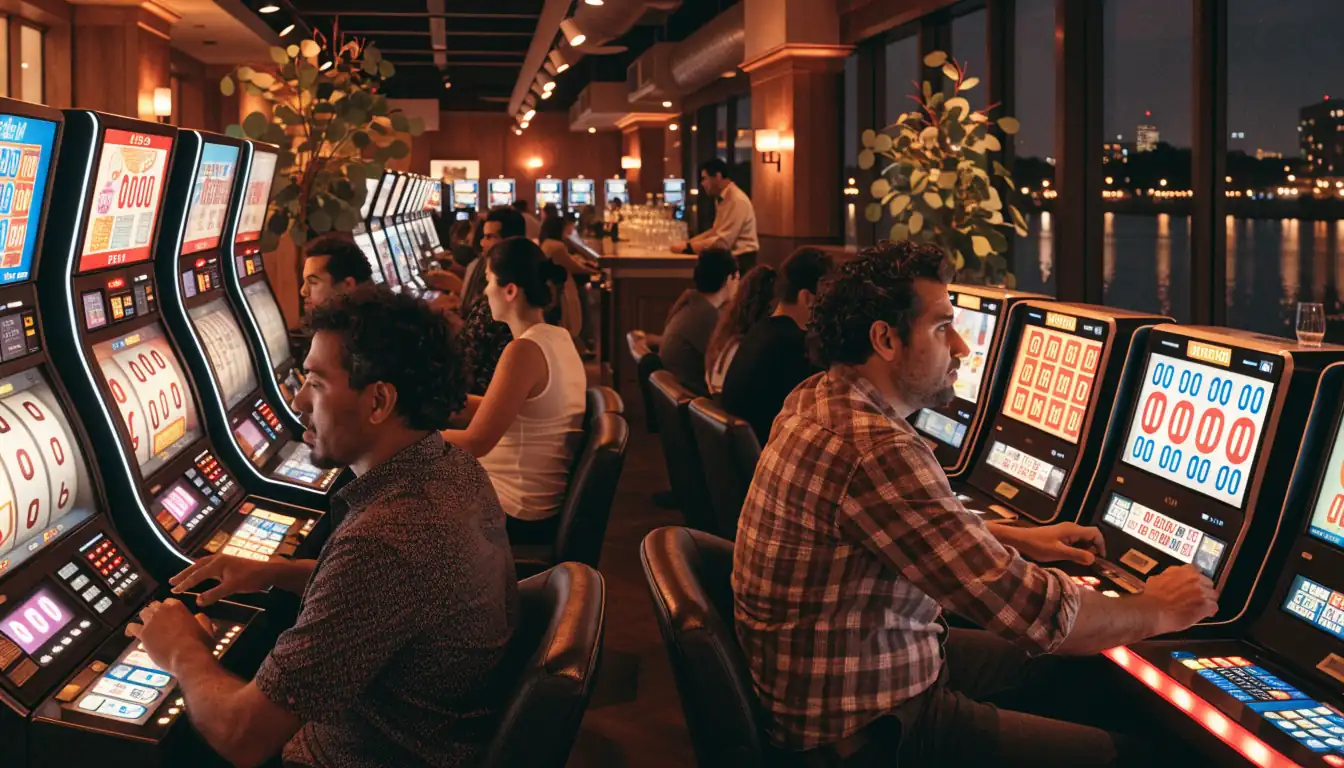
This is also where the gap between physical machines and online pokies becomes concrete rather than theoretical. According to one industry comparison, physical pokies typically carry RTPs in the region of 85%–92%, while online slots typically run in the 96%–98% range. That’s a meaningful spread — not a rounding difference, a structural one.
Typical RTP range: 85%–92% (lower due to floor overheads).
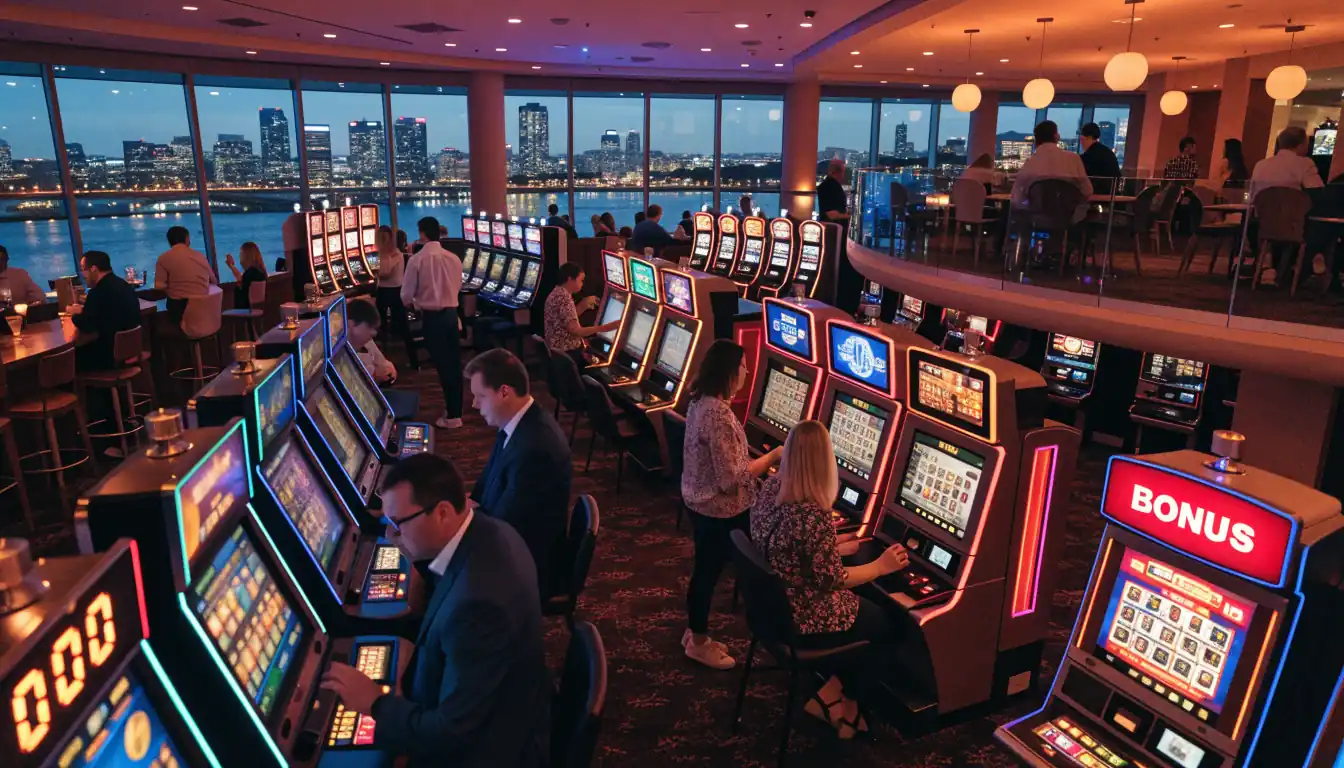
Typical RTP range: 96%–98% (higher because no physical costs).
The reason isn’t mysterious once you think about the economics on each side. A physical cabinet has floor space, power, maintenance staff, and a venue’s overheads baked into its cost structure; the machine has to earn its keep in a fixed location with fixed running costs. An online game has none of that physical overhead, and with dozens or hundreds of competing titles a click away, a studio that sets its RTP too low simply loses players to a competitor’s game. Competition on the internet is instant in a way it never is on a casino floor, and RTP is one of the few numbers a player can actually compare before playing.
None of that changes the core mechanic — RNG, independence of spins, long-run averages — it changes what a "typical" outcome looks like on that floor of games versus this one.
Volatility: the shape of the ride, not the size of the destination
If RTP tells you what a game gives back over time, volatility describes how a pokie tends to pay along the way. Two games can carry the same RTP and feel completely different to play, because volatility governs the size and frequency of individual wins, not the total return.
A low-volatility game tends to pay smaller amounts more often. Sessions on these games feel smoother — the balance dips and recovers in small increments, rarely swinging hard in either direction. A high-volatility game does the opposite: long stretches without a meaningful win, punctuated by payouts large enough to make up for the drought, at least in theory. Medium-volatility games sit between the two, and most players who’ve spun enough titles develop a rough instinct for which bucket a game falls into within the first few minutes, even before checking the stated volatility rating.


The practical consequence that matters most, and the one worth taking seriously rather than treating as a footnote: high-volatility pokies can quickly deplete a session budget. This isn’t a moral warning, it’s a description of variance doing exactly what variance does. A bankroll sized for a smooth, low-volatility session can be gone in a fraction of the spins on a high-volatility title, purely because the payout structure is built around occasional large hits rather than steady small ones. The RTP might be respectable on paper. The volatility is what decides whether that respectable number gets a chance to express itself before the budget runs out.
This is worth sitting with because it’s the single most common way players misjudge a game. They check the RTP, see a good number, and assume the session will behave accordingly. It might — over enough spins. But volatility decides the shape of the road between here and "enough spins," and a lot of budgets don’t survive the road.
Reading the two together
RTP and volatility aren’t competing metrics — they’re answering different questions, and a game only makes sense once you’ve asked both.
| Question | Answered by |
|---|---|
| What does this game return over a very long run? | RTP |
| How lumpy or smooth is the path to that return? | Volatility |
| Will a modest bankroll survive a normal session? | Volatility, primarily |
| Is the game mathematically fair over time? | RTP, primarily |
A high-RTP, high-volatility game can still be brutal on a tight budget in the short term. A lower-RTP, low-volatility game can feel perfectly pleasant to play even though it’s mathematically giving back less over time. Neither number alone tells the whole story, which is exactly why studios and, at times, marketing copy lean on whichever number flatters the game and leave the other one in the small print.
Adjustable volatility has become a feature in its own right on some newer titles, letting a player choose a volatility profile within the same base game rather than accepting whatever the studio defaulted to. It’s a genuinely useful option where it exists, because it puts some of that short-run risk decision back in the player’s hands instead of leaving it baked silently into the game’s design.
Bonus buys: paying to skip the wait
Bonus buy features have become common enough on newer pokies that they deserve their own explanation, separate from RTP and volatility, because they change the shape of a session in a different way again.
Bonus‑buy features compress the variance of a session: you pay to skip base‑game spins and jump straight into the bonus round, which changes the volatility experience but does not improve the underlying RTP.
A standard pokie triggers its bonus round — free spins, a pick-a-prize screen, whatever the theme dresses it up as — through in-game symbols landing by chance during normal play. A bonus buy feature lets a player skip that wait and pay directly for entry into the bonus round instead. Some pokie games feature bonus buy options, though it’s a feature that varies title by title rather than something built into every game, and one industry review’s framing of how these features are typically priced and structured shouldn’t be read as universal across every studio.
What’s worth understanding is the mechanical trade-off rather than treating a bonus buy as simply "the bonus round, but paid for." Studios generally price these features around the game’s underlying RTP, meaning the mathematics of the bonus buy is folded back into the same long-run number that governs the base game — it’s not a separate, unregulated side bet sitting outside the game’s stated RTP. But paying to enter a bonus round removes the (sometimes long) natural build-up of base-game spins, and that changes the volatility experience of a session dramatically. A player who buys straight into bonus rounds repeatedly is choosing to compress a session’s variance into a much shorter stretch of spins, for better or worse, rather than letting it unfold at the game’s natural pace.
That’s not a criticism of the feature. Some players genuinely prefer that compression — they’d rather spend a fixed amount to see the bonus mechanics directly than grind base spins hoping to trigger them. It’s a legitimate preference. But it’s worth naming plainly: a bonus buy is not a shortcut to better odds, it’s a different distribution of the same odds, spent faster.

What a specification sheet actually tells you
It helps to look at how these pieces sit together on an actual title rather than in the abstract. Mighty Wild: Panther, according to one industry breakdown of the game, carries an RTP of 96.15%, adjustable volatility, a maximum win of 750x the stake, and 15 paylines, alongside bonus buys, multipliers, respins, and a gamble feature.
Read that specification the way it’s meant to be read, piece by piece, and it stops being marketing copy and starts being a set of decisions:
- RTP 96.15% — a solid long-run figure, comfortably inside the range typical of online pokies rather than physical cabinets.
- Adjustable volatility — the player, not just the studio, gets some say in how lumpy the session feels.
- Max win 750x — this caps what any single spin can realistically return, which matters for anyone chasing a specific outcome rather than just playing the game as designed.
- 15 paylines — a moderate spread, neither the minimalism of a three-line classic nor the sprawl of a mega-ways title.
- Bonus buys, multipliers, respins, gamble feature — a stack of mechanics that each interact with volatility differently; a gamble feature, for instance, is its own miniature bet layered on top of a win, with its own separate risk that has nothing to do with the base RTP.
None of those five facts, read alone, describes the game. Read together, they describe a specific kind of session: reasonably fair over time, with the volatility dial in the player’s hands, a hard ceiling on the size of any one win, and several optional ways to compress or extend the pace of play. That’s the level of detail worth applying to any pokie before treating its RTP badge as the whole story.
Filtering games instead of guessing
One practical upside of playing online rather than on a physical floor is that these attributes are usually filterable rather than something a player has to hunt for game by game. Players can filter games by provider, volatility, and features, which turns game selection from a guessing exercise — walking a casino floor reading cabinet artwork — into something closer to a spec comparison. Wanting a low-volatility session with no bonus buy, from a specific studio whose output has been reliable in the past — that’s a filterable request rather than a matter of luck and memory.
This matters more than it sounds. On a physical floor, volatility and RTP information simply isn’t displayed anywhere a player can see before sitting down. Online, it’s frequently part of the game’s own information panel, and filtering by it turns a session from reactive ("this one looked fun") into deliberate ("this matches the bankroll and mood I’ve got tonight"). Whether a given platform’s filtering is genuinely thorough is a separate question from the mechanics themselves, and one that belongs with the casino-level comparison rather than here — the point at game level is simply that the option to choose on these terms exists at all, which it doesn’t on a cabinet.
Who checks that any of this is true
None of the numbers above mean much without someone independently confirming that the RNG behind them is actually random and that the stated RTP is what the game genuinely returns over its tested run. That verification work falls to independent testing labs rather than the studios or operators themselves. iTech Labs and eCOGRA are the two names that come up most often in this role — they test RNG outputs and verify the RTPs that studios report for their games.

This distinction is worth being explicit about, because it’s easy to conflate "the operator says this game is fair" with "an independent party checked." They’re not the same claim. A studio publishing an RTP figure is a statement of intent backed by its own internal math; a lab certifying that figure is an outside party rerunning the numbers and confirming the game behaves as advertised across a large enough sample to mean something. The presence of a recognised testing lab’s certification on a game is one of the few concrete, checkable facts a player has access to before ever placing a bet — considerably more useful than a review’s adjectives.
It’s also worth being honest about the limits of that verification. Testing labs confirm that a game’s RNG is genuinely random and that its RTP matches what’s reported — they don’t regulate how a casino presents that game, bundles it into a bonus, or weights it within a promotion. Certification is a statement about the game, not about the operator wrapped around it. Where an operator sits, what it’s licensed under, and how its bonus terms are structured is a separate layer of the picture — one that belongs with the casino itself rather than with any single title on its lobby.
Why the distinction between game and casino matters here
It’s tempting to blur game-level facts and casino-level facts into one impression — "this casino has good pokies" — but they’re answering different questions and worth keeping separate on purpose. A game’s RTP, volatility, and certification describe the game, full stop; they don’t change depending on which platform hosts it, because the same certified title behaves identically wherever it’s loaded. What does change from platform to platform is everything sitting around the game: how fast withdrawals move, what a welcome offer actually requires, how the lobby is organised, what payment methods are supported.
Confusing the two leads to bad conclusions in both directions. A platform with a slow withdrawal process doesn’t make its certified games less fair — the RNG doesn’t know or care which casino it’s running in. Equally, a well-run platform with fast payouts doesn’t make an individual high-volatility game gentler on a bankroll — the game’s payout structure is exactly what it is regardless of how smoothly the operator processes cashouts. Treating game mechanics and casino operations as two separate questions, checked separately, is the only way to actually evaluate either one honestly.

The honest version of what all this adds up to
Strip away the theming, the sound design, the animated symbols, and a pokie is a fairly simple object: a certified random number generator, a long-run return figure describing what it pays back over a very large number of spins, and a volatility profile describing how lumpy the path to that figure will be. Bonus buys and adjustable volatility give a player some influence over the shape of a session, but none of it changes the fundamental fact that each spin is an independent, random event, and that the advertised RTP is a statement about millions of spins, not about tonight.
Understanding that distinction doesn’t make anyone win more. It does mean a losing session on a well-certified, fairly-rated game isn’t evidence of anything sinister — it’s variance doing what variance does, on a timescale much shorter than the one the RTP figure was ever describing.

Perth Casino Landscape: Crown Perth and Online Options
Western Australia runs one of the tightest gaming regimes in the country, and it shows the moment you try to find a physical floor to play on. There’s exactly one option, and it sits on the Swan River.
Crown Perth: the only room in town
Crown Perth holds the sole licence for traditional poker machines anywhere in Western Australia. Not "the biggest" or "the best known" — the only one. Every other state has multiple licensed venues competing for foot traffic; WA deliberately doesn’t. That’s not an oversight, it’s policy, and it’s why access to a physical machine here is narrower than almost anywhere else in Australia. If you’re not within driving distance of Burswood, there’s no local alternative venue to fall back on.
That scarcity is the whole story of why online options exist at all for WA players. When there’s one room and it’s not always convenient, people look elsewhere — and elsewhere, for pokies specifically, means offshore.

Where "online" actually sits, legally
I want to be precise here because this is the part rewritten loosely on most casino blogs. Australian law doesn’t licence online casino games — not slots, not roulette, not blackjack — for operators serving Australian residents. There is no domestic licence to point to, and no local regulator issuing one. What exists instead is a patchwork of offshore-licensed platforms, most commonly under Curaçao eGaming, that accept Australian players without being licensed in Australia themselves.
The law is written to catch operators, not players. Sitting down and spinning a reel on an offshore site isn’t the illegal act — running the site targeting Australians without local authorisation is. That distinction matters because it explains why these platforms exist in a kind of parallel lane: visible, widely used, but never described here as "licensed to operate in Australia," because that licence doesn’t exist and never will under current law.
So when a site online promises "fully licensed and regulated" pokies for Perth players, ask which regulator. If the answer is a state or federal Australian body, that’s not accurate — no such body issues that licence. If the answer is Curaçao, that’s at least honest about where the paperwork actually sits.

What changes when you move from the floor to the browser
Crown Perth’s machines are what they are — fixed hardware, fixed rules, one location. Offshore platforms operate on a different logic entirely, and the differences aren’t cosmetic.
- Access isn’t geographic. A platform licensed out of Curaçao doesn’t care what suburb you’re in. That’s the entire appeal for anyone outside Perth’s metro area.
- Bonusing exists in a way it doesn’t on the floor. Welcome offers built around deposit matches and free spins are standard on these platforms — a mechanic that simply has no equivalent at a physical venue, where the “bonus” is whatever loyalty points the floor hands out.
- Withdrawals move differently. According to one operator’s own published terms, some of these platforms support fast crypto withdrawals — a claim worth treating as exactly that: one operator’s claim, not an industry-wide guarantee. Speed varies by platform and by method, and nobody in this space benefits from you assuming otherwise.
None of this makes the online option "better" than Crown Perth — it makes it a different product operating under a different, foreign licensing framework, with different incentives built into how it’s marketed. Worth knowing before you read a welcome bonus as a sign of generosity rather than a customer acquisition cost.
The self-exclusion question
Crown Perth, as a licensed WA venue, runs its own self-exclusion program, consistent with the state’s approach to harm minimisation under its gaming laws. Offshore platforms sit outside that system entirely — there’s no shared register, no cross-venue enforcement, because they’re not part of the WA regulatory structure to begin with. If self-exclusion matters to you, it has to be arranged separately with each platform, and it won’t carry over from one to the next.
What this landscape actually looks like
Two categories, not a spectrum:
- Crown Perth — the single legal venue for physical poker machines in WA, subject to state licensing and self-exclusion frameworks.
- Offshore-licensed online platforms — accessible to Australian players, typically under Curaçao eGaming, operating outside Australian jurisdiction, with their own bonus structures and withdrawal methods that vary by operator.
Nothing in between. No second physical venue, no domestically licensed online alternative. Just those two lanes, and whichever one you’re in, it’s worth being honest with yourself about which set of rules actually applies.
Perth Pokies Payout Percentages: What Players Can Expect
RTP is a theoretical figure, calculated over millions of spins, not a promise about any single session. It tells you where the machine’s return sits in the long run, nothing about what happens in the next hour.
One industry review put physical pokies in the 85%-92% RTP range, against 96%-98% for online slots. That’s a wide enough gap that the venue itself, not just the game, decides how much of your money theoretically comes back over time. A machine on a physical floor and the same-branded slot online are not the same bet.
I wouldn’t treat those figures as fixed law. They came from one comparison, not a regulator’s audit, and the numbers shift by machine and by operator. What holds up regardless: a lower theoretical range means the house edge does more work against you, spin after spin. Worth knowing before you sit down.
Do Australian-friendly casinos offer free spins and pokie bonuses?
Yes, welcome bonuses commonly include deposit matches and free spins, and some platforms go further — Boho Casino offers a no deposit bonus and cashback, while Slots Gallery offers daily cashback of up to 12.5% and Winz offers bonuses with no wagering requirement.
Can I play online pokies for free?
Yes, most platforms let you filter and try pokie titles in demo mode before wagering real money, so you can test a game’s volatility and features without touching your bankroll.
Can I play crypto casino games on my mobile device?
Yes, the platforms serving Australian players offer mobile-friendly, browser-based interfaces, and several of them support fast crypto withdrawals, so you can play and cash out on mobile without a dedicated app.
What is the best time to visit the casino in Perth to avoid crowds?
The article doesn’t cover timing, but it does note that Crown Perth is the only legal venue for traditional poker machines in Western Australia — access to physical casinos is limited by the state’s strict gaming laws, so expect a single concentrated venue rather than spread-out options.
What are the common responsible-gaming utilities offered by reputable online casinos?
Reputable platforms typically provide tools like deposit limits, session reminders, self-exclusion and cooling-off options, letting you set boundaries before variance does it for you — especially important on high-volatility titles that can drain a session budget quickly.